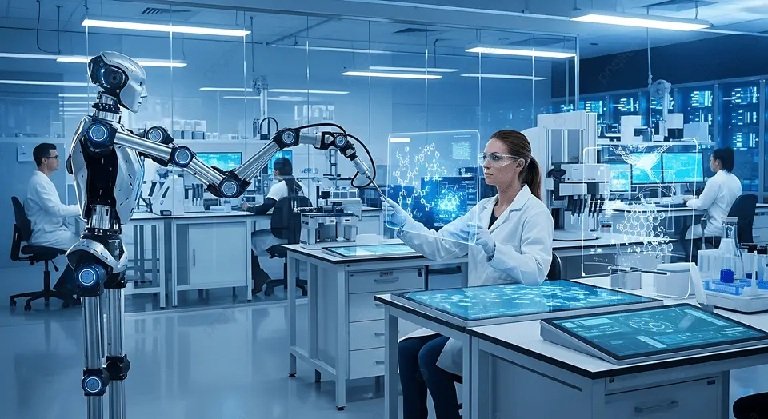

Not long ago, Artificial Intelligence felt like something from a science-fiction movie. People imagined robots taking over the world or computers becoming smarter than humans overnight. But in 2026, AI is no longer just an idea or a futuristic dream. It has quietly become part of everyday life.
When you ask a voice assistant a question, receive movie recommendations online, or use tools that write emails or generate images, you are already interacting with AI. What many people don’t realize is that behind these simple tools lies a massive global competition.
The world’s biggest technology companies are racing to build the most powerful artificial intelligence systems. This competition is often called the global AI race, and in 2026 it is moving faster than ever.
Why AI Has Become So Important
Artificial Intelligence has grown rapidly in the last decade. Earlier AI systems could only perform basic tasks like recognizing images or organizing data. Today, AI can do far more complex things.
Modern AI systems can write articles, generate music, design graphics, analyze medical scans, and even help scientists discover new drugs. Businesses have quickly realized how valuable this technology can be.
For companies, AI means working faster, making smarter decisions, and saving time and money. Instead of spending hours analyzing data, AI systems can process huge amounts of information in seconds.
Because of this, organizations around the world are investing heavily in artificial intelligence.
Tech Giants Leading the Competition
The companies leading the AI race are some of the biggest names in technology, including Google, Microsoft, Amazon, Apple, and Meta.
Each of these companies is trying to build powerful AI systems that can change the way people work and communicate. Some focus on creating advanced AI assistants, while others develop AI tools for businesses or cloud computing platforms.
The competition is intense. Whenever one company launches a new AI model, other companies quickly respond with their own innovations.
It’s similar to a technology arms race, where every new breakthrough pushes competitors to move even faster.
The Hidden Power Behind AI: Computing Infrastructure
While AI tools may look simple from the outside, they require enormous computing power behind the scenes.
Training advanced AI models involves processing massive amounts of data. To do this, companies build huge data centers filled with powerful servers and specialized processors.
These data centers operate day and night, running complex calculations that allow AI systems to learn patterns and improve their performance.
Some technology companies are even building AI supercomputers designed specifically for artificial intelligence research.
In many ways, the real battle in the AI race is not just about software. It is also about who has the strongest computing infrastructure.
Data: The Fuel That Makes AI Work
Another important factor in the AI race is data. Artificial intelligence systems learn from data, much like humans learn from experience.
The more data an AI model can analyze, the better it becomes at recognizing patterns and making predictions.
Large technology companies have an advantage here because their platforms generate enormous amounts of data every day. Search engines, online stores, social networks, and video platforms collect valuable information that can help train AI models.
However, the use of data also raises serious questions about privacy and security. Many people worry about how their information is used and whether companies should have access to so much data.
Because of these concerns, governments around the world are working on new rules to regulate AI development.
Governments Entering the AI Race
Interestingly, the competition for AI dominance is not limited to technology companies. Governments are also becoming deeply involved.
Countries see artificial intelligence as a technology that could shape the future of their economies and national security. Because of this, many governments are funding research programs and supporting AI startups.
Some experts even compare today’s AI race to the space race of the 20th century, when countries competed to send astronauts into space.
In the modern world, however, the competition is not about rockets. It is about who can build the most powerful and reliable AI systems.
AI Changing Everyday Industries
While the rivalry between tech companies often dominates headlines, the real impact of artificial intelligence can be seen across many industries.
In healthcare, AI is helping doctors detect diseases earlier and analyze medical images more accurately. In finance, AI systems are identifying suspicious transactions and improving risk management.
Education is also changing. AI-powered learning platforms can adapt lessons based on how students learn, making education more personalized.
Even creative industries are being transformed. AI can now generate artwork, music, videos, and written content, giving creators new tools to experiment with.
This rapid expansion of AI technology is opening opportunities that were almost impossible to imagine just a few years ago.
The Challenges That Come With AI
Despite its many advantages, artificial intelligence also raises important concerns.
One major issue is job displacement. As automation becomes more advanced, some traditional jobs may disappear or change significantly.
Another concern is AI bias. If an AI system is trained using biased data, it may produce unfair results.
There is also growing worry about AI-generated misinformation, where realistic images, videos, or text could be used to spread false information.
Because of these risks, many experts believe that AI development must be guided by strong ethical standards and responsible regulations.
Technology companies are already investing in AI safety research to ensure their systems behave in ways that benefit society.
What the Future Might Bring
The global AI race is still just beginning. Over the next decade, artificial intelligence could become even more powerful and widely used.
Future AI systems might help scientists solve complex problems such as climate change, disease prevention, and energy efficiency. Businesses may rely on AI to manage operations, analyze markets, and create new products.
At the same time, collaboration between companies, governments, and researchers will be essential to ensure that AI technology is used responsibly.
The goal is not just to build powerful machines but to ensure that AI improves human life rather than creating new problems.
Conclusion
The global AI race in 2026 is shaping the future of technology in ways we are only beginning to understand. Tech giants are investing billions of dollars, governments are developing national strategies, and researchers are pushing the limits of what machines can do.
Behind all the competition lies a simple reality: artificial intelligence is becoming one of the most important technologies of our time.
The companies and countries that succeed in this race may define how the digital world evolves in the decades ahead. But the true success of AI will not just depend on power or innovation.