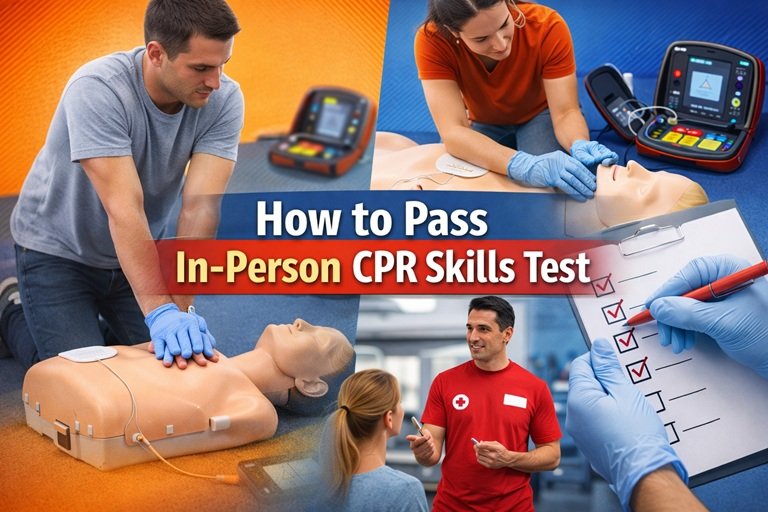

Let’s be honest—most people don’t fail a CPR skills test because it’s “too hard.” They fail because of nerves, confusion, or missing small but important details.
If you’re preparing for how to pass in-person CPR skills test, you’re already ahead of the game. Why? Because preparation is literally 70% of success here.
This guide is not some boring textbook-style explanation. Instead, think of it as your practical, real-world cheat sheet—what examiners actually look for, what mistakes cost you marks, and how to walk into that test feeling calm and confident.
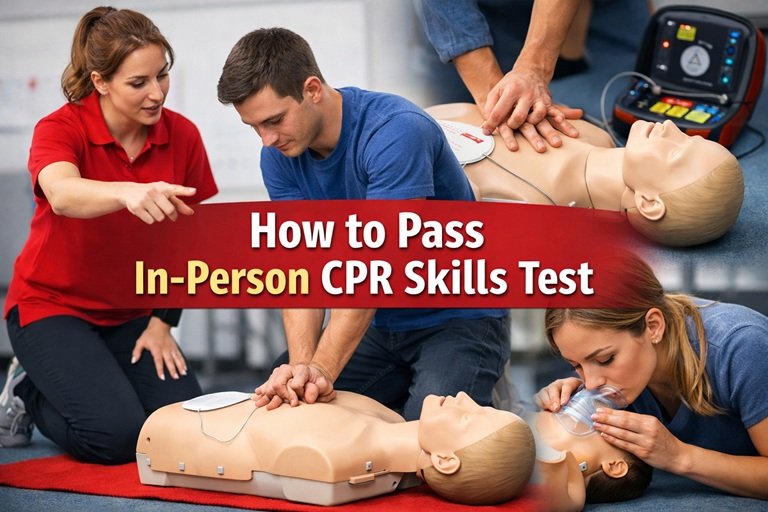
Understanding the In-Person CPR Skills Test
Before you even think about passing, you need to understand what you’re being tested on.
The in-person CPR skills test is designed to evaluate whether you can perform life-saving techniques correctly in a real-world scenario. It’s not about memorizing theory—it’s about execution.
Most tests follow guidelines from organizations like the American Heart Association or Red Cross.
What the examiner typically checks:
- Scene safety awareness
- Proper body positioning
- Correct chest compression technique
- Compression depth and rate
- Rescue breathing (if required)
- AED usage
- Confidence and flow
According to CPR guidelines, compressions should be 100–120 per minute and at least 2 inches deep . That’s not just theory—it’s something examiners actively watch.
Table of Contents
- Understanding the In-Person CPR Skills Test
- What Happens During the CPR Test
- Step-by-Step CPR Skills You Must Master
- Scene Safety Check
- Checking Responsiveness
- Calling for Help
- Checking Breathing
- Chest Compressions
- Rescue Breaths
- AED Usage
- Top 7 Proven Tips to Pass the CPR Skills Test
- Common Reasons People Fail (And How to Avoid Them)
- Mental Preparation: The Hidden Key to Success
- What Examiners Really Look For
- Best Practice Routine Before Test Day
- What to Do One Day Before the Test
- Test Day Strategy: Step-by-Step Plan
- Real-Life Importance of CPR Skills
- Final Conclusion
What Actually Happens During the Test
Knowing the structure reduces anxiety instantly.
Typical test flow:
- You’re given a scenario (e.g., unconscious adult)
- You approach and assess the situation
- Perform CPR on a mannequin
- Possibly demonstrate AED use
- Instructor evaluates silently (most of the time)
Important:
This is not a “trick exam.” It’s a checklist-based assessment. If you follow the steps correctly, you pass.
Step-by-Step Breakdown of CPR Skills You Must Master
Let’s break down exactly what you need to perform—this is the backbone of how to pass in-person CPR skills test.
1. Scene Safety Check
Before touching the victim:
- Look around
- Ensure no danger (traffic, fire, electricity)
If you skip this, you lose points immediately.
2. Check Responsiveness
- Tap shoulders
- Shout: “Are you okay?”
This shows awareness and proper protocol.
3. Call for Help
- Ask someone to call emergency services
- Request AED
Even if you’re alone, verbalizing this step matters.
4. Check Breathing
- Look for chest movement
- Take no more than 10 seconds
If no breathing → start CPR immediately.
5. Start Chest Compressions (The Most Important Part)
This is where most people either pass or fail.
Key things examiners look for:
- Hands in center of chest
- Arms straight
- Shoulders directly over hands
- Use body weight (not just arms)
Correct technique:
- Depth: at least 2 inches
- Rate: 100–120 compressions/min
- Full chest recoil
- Minimal interruptions
High-quality compressions are critical for survival.
6. Rescue Breaths (If Required)
- 30 compressions → 2 breaths
- Ensure visible chest rise
If breaths are weak or incorrect, you lose marks.
7. Use of AED
- Turn it on immediately
- Follow voice prompts
- Ensure no one touches during shock
Top 7 Proven Tips to Pass Your CPR Skills Test
Let’s get practical. These are the real tips that make a difference.
1. Practice Like It’s Real (Not Casual Practice)
Don’t just “try it once.” Practice like you’re being evaluated:
- Full sequence
- No shortcuts
- Speak steps out loud
2. Master the Compression Rhythm
Think of songs like:
- “Stayin’ Alive”
- “Another One Bites the Dust”
These match the 100–120 BPM requirement.
3. Focus on Body Mechanics
Most failures happen due to poor posture:
- Bent elbows = weak compressions
- Leaning incorrectly = poor depth
Fix this early.
4. Don’t Skip Verbal Steps
Even if it’s obvious:
- Say “calling emergency services”
- Say “checking breathing”
Examiners can’t read your mind.
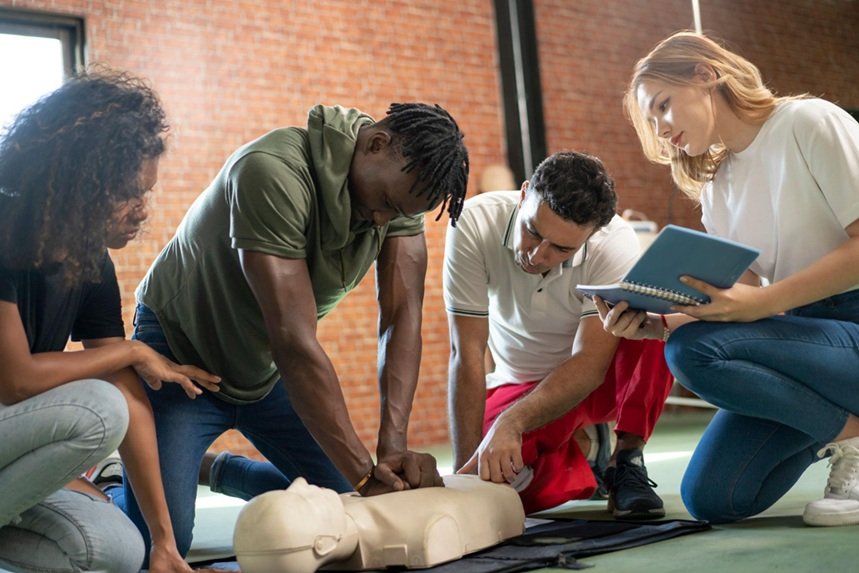
5. Stay Calm (Seriously, This Matters)
Nervous students:
- Rush steps
- Forget sequence
- Panic during AED
Take a breath. The mannequin isn’t judging you.
6. Avoid Common Mistakes
Big ones include:
- Shallow compressions
- Incorrect hand placement
- Forgetting chest recoil
- Skipping safety check
Even one major mistake can cost your pass.
7. Watch Real Demonstrations Before Test Day
Watching real demonstrations helps you:
- Understand flow
- Improve confidence
- Learn timing
Common Reasons People Fail (And How to Avoid Them)
Let’s be brutally honest—most failures are predictable.
1. Poor Compression Quality
If compressions are too shallow or slow, you fail.
2. Incorrect Sequence
CPR follows C-A-B (Compressions, Airway, Breathing)
Mixing the order = deduction.
3. Lack of Confidence
Hesitation signals lack of readiness.
4. Not Practicing Enough
Reading ≠ doing.
Mental Preparation: The Hidden Key to Passing
This is underrated but powerful.
Before the test:
- Visualize the steps
- Practice calmly
- Sleep well
During the test:
- Think step-by-step
- Don’t rush
- Reset if needed
Confidence often matters as much as skill.
What Examiners Really Look For (Insider Insight)
Examiners don’t expect perfection.
They look for:
- Correct technique
- Logical sequence
- Safe handling
- Consistency
If you make a small mistake but recover correctly—you’ll likely still pass.
Practice Routine That Actually Works
Here’s a simple but powerful routine:
Daily 15–20 min plan:
- 5 min: Watch or review steps
- 10 min: Hands-on practice
- 5 min: Full simulation
Repeat for 3–5 days before test.
Day Before the Test: What You Should Do
Keep it simple:
- Light practice
- Review steps
- Don’t overthink
Avoid cramming. This isn’t a theory exam.
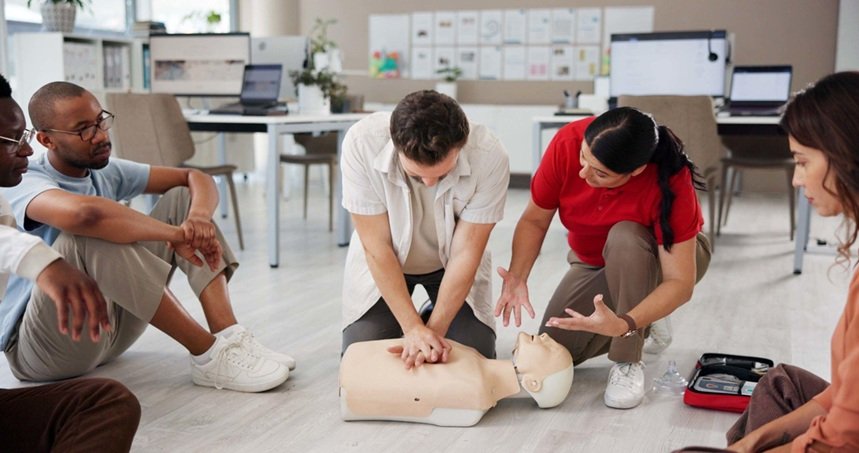
On Test Day: Step-by-Step Strategy
Walk in with a plan:
- Stay relaxed
- Listen carefully to instructions
- Perform confidently
- Speak steps clearly
If you forget something:
Pause → think → continue.
Real-Life Importance of CPR Skills
Let’s zoom out for a second.
CPR isn’t just about passing a test. It’s about saving lives.
- Cardiac arrest can happen anywhere
- Immediate CPR can double survival chances
- Even basic skills make a huge difference
When you master this, you’re not just passing—you’re becoming someone who can act in emergencies.
Conclusion
Mastering how to pass in-person CPR skills test isn’t about memorizing steps—it’s about performing them with confidence, accuracy, and calmness under pressure. Throughout your preparation, the key is consistent practice, understanding proper technique, and avoiding common mistakes like poor compression depth or skipping critical steps.
On test day, success comes down to staying composed, following the correct sequence, and demonstrating clear, confident actions. Remember, examiners are not looking for perfection—they want to see that you can handle a real-life emergency effectively and safely.
If you’ve practiced well, trust your training and go step by step. Even if you feel nervous, focus on delivering high-quality compressions, proper breathing, and correct AED usage. Small corrections during the test are okay—as long as you stay in control.