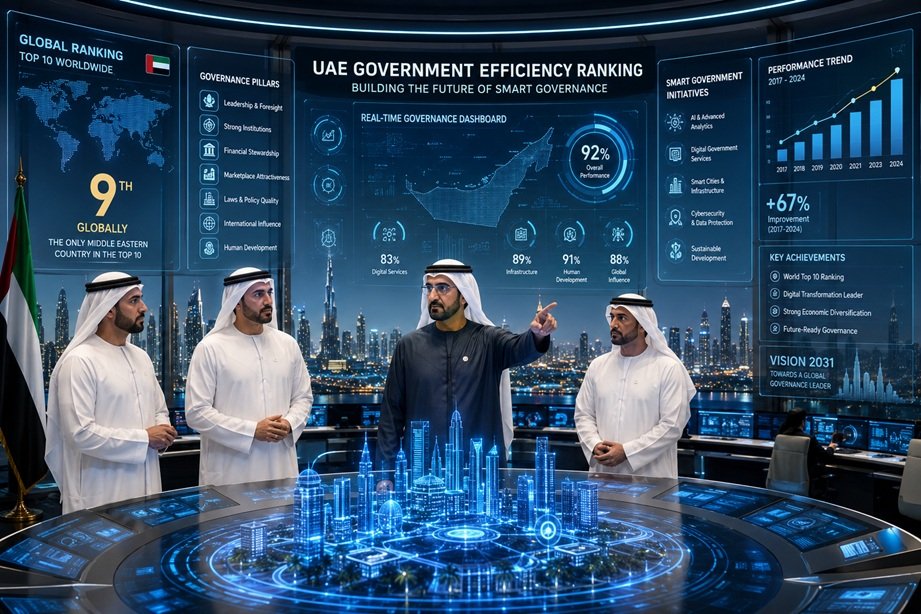

Government effectiveness seldom makes headlines. Discussions usually center on economic growth, technology, tourism, or infrastructure, yet the effectiveness of governance subtly impacts all these areas. Recently, there has been a global focus on the UAE Government efficiency ranking, particularly as the nation secured one of its best standings in worldwide governance evaluations.
This progress has ignited discussions among policymakers, analysts, and business executives. What factors propelled the United Arab Emirates into the global limelight? Was it advancements in technology? Strategic financial management? Leadership qualities? Or a blend of various reforms implemented together?
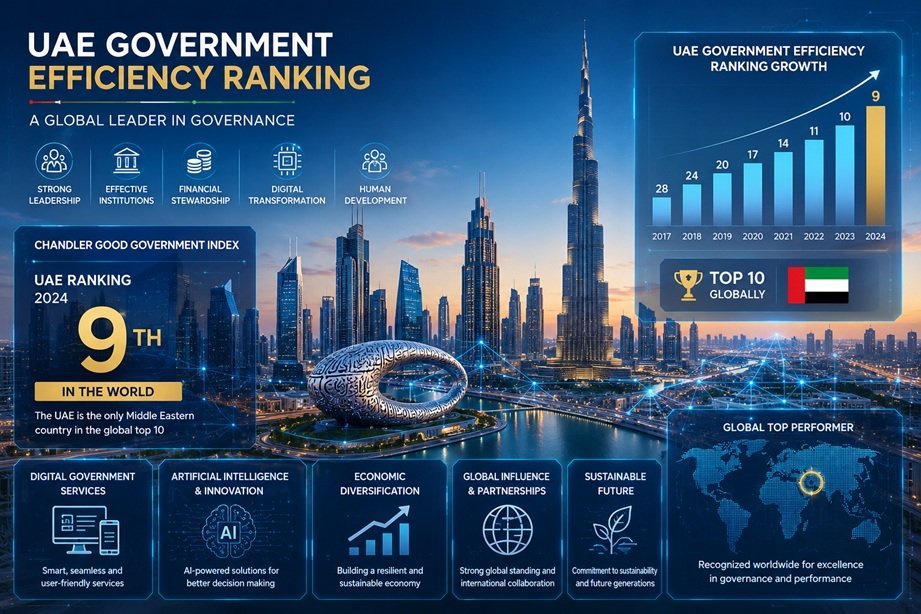
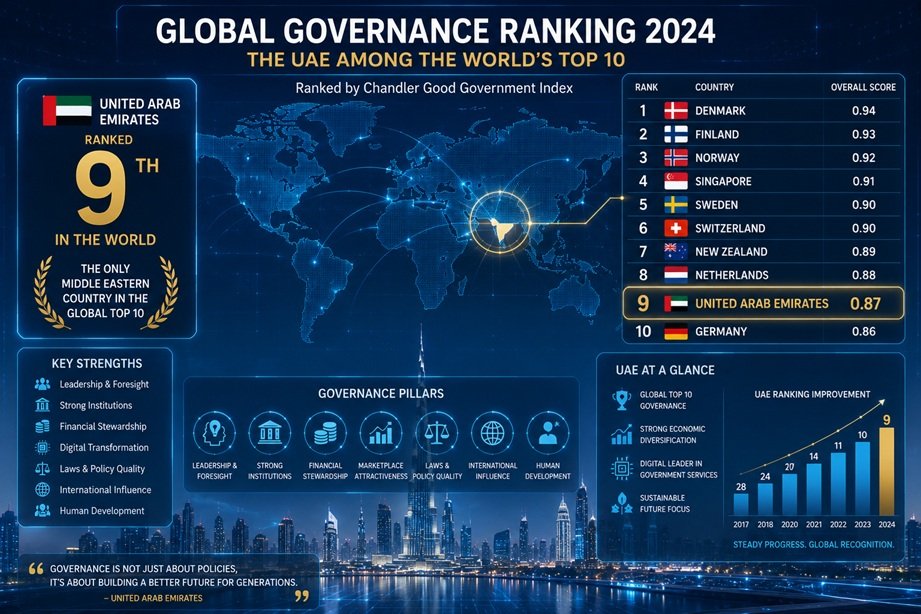
Recent international evaluations indicate that the UAE has ascended to the upper echelons of effective governments worldwide and continues to be a leading performer in the Middle East. The most current Chandler Good Government Index places the UAE in the global top ten, marking it as the sole Middle Eastern nation in that prestigious list.
The narrative behind this accomplishment extends well beyond mere rankings. It represents years of institutional evolution, strategic planning, and modernization initiatives.
Understanding Global Government Performance Measurements
In global comparisons, nations are evaluated on more than just economic performance. Researchers are increasingly interested in whether governments can manage their institutions effectively, generate opportunities, and meet challenges head-on.
The Chandler Good Government Index assesses countries based on a variety of indicators categorized into seven primary pillars.
These are:
- Leadership and foresight
- Strong institutions
- Financial stewardship
- Marketplace attractiveness
- Laws and policy quality
- International influence
- Human development outcomes
This index examines 120 countries and evaluates governance performance through numerous measurable factors.
Such a comprehensive viewpoint clarifies why contemporary governments prioritize agility and long-term strategies over transient achievements.
Why the UAE’s Rise Drew Global Attention
The shift in the UAE Government efficiency ranking has been significant.
Data indicates that the country has improved greatly in recent years, achieving the ninth position globally in the Chandler Good Government Index. It also marked one of the largest advancements among the nations analyzed in this study.
An improvement of this magnitude is rare since governance metrics typically evolve slowly.
Nations often dedicate decades to enhancing their:
- Administrative frameworks
- Legal systems
- Institutional effectiveness
Rapid progress usually signals synchronized reforms across multiple sectors.
Consequently, the UAE’s ascent has attracted the attention of international analysts seeking instances of modern governance evolution.
Leadership and Long-Term Planning
A prominent theme in the nation’s advancement is its strategic leadership.
Rather than depending solely on immediate policies, UAE initiatives frequently revolve around long-term national visions.
Illustrative examples include:
- Economic diversification strategies
- Artificial intelligence initiatives
- Digital transformation plans
- Future-focused urban development
- Sustainability programs
Global evaluations have ranked the UAE among the best performers internationally in terms of leadership and foresight.
This highlights a governance style aimed at anticipating challenges before they arise.
Nations that excel in long-term planning often rebound more swiftly during economic downturns and global instability.
The Power of Future-Focused Decision Making
Conventional governance typically reacts only after crises occur.
The UAE model increasingly prioritizes:
- Forecasting
- Preparedness
- Innovation
Instances of this approach comprise smart city initiatives, digital government services, and the integration of advanced technology.
These methods minimize administrative hindrances and enhance operational efficiency.
In multiple evaluations on a global scale, governments that adeptly foresee upcoming issues tend to achieve higher rankings.
Digital Transformation Altered Public Services
A significant factor contributing to the efficiency rating of the UAE Government relates to its digital advancements.
Throughout the previous ten years, governmental services have progressively transitioned to cohesive digital frameworks.
Both citizens and businesses found it simpler to access:
- Licensing services
- Visa processing
- Healthcare systems
- Government approvals
- Payment systems
- Legal procedures
The integration of digital technologies can significantly boost productivity by minimizing paperwork, delays, and redundancy.
For individuals and enterprises, swifter access often fosters a belief in enhanced governance.
In the context of international evaluations, observable enhancements in service delivery bolster institutional rankings.
Smart Government and Artificial Intelligence
Technology is becoming pivotal in contemporary public administration.
The UAE has made substantial investments in initiatives related to artificial intelligence and automation.
These investments facilitate:
- Predictive government services
- Data analysis systems
- Intelligent infrastructure
- Automated procedures
- Digital identity platforms
Nations are increasingly vying not only based on economic performance but also on technological advancement.
Governments that can quickly process data and effectively deliver services typically possess significant competitive advantages.
Experts often highlight digital readiness as a vital element of governance.
Financial Management Became a Significant Asset
Economic oversight has also been a crucial factor.
The enhancement of the UAE Government efficiency ranking can be partially attributed to improved financial management practices.
Robust financial frameworks frequently encompass:
- Balanced fiscal planning
- Effective public expenditure
- Stable investment climates
- Diversified revenue sources
- Sustainable development strategies
The UAE achieved exceptionally high ratings in financial aspects.
Effective economic planning becomes particularly vital during periods of worldwide uncertainty.
Nations with adaptable and diverse systems often excel under stress.

Shifting Beyond Oil Reliance
Historically, numerous Gulf economies have depended significantly on oil revenues.
Nevertheless, the UAE has progressively transitioned away from that reliance.
Emerging sectors now feature:
- Tourism
- Financial services
- Technology
- Logistics
- Renewable energy
- Aviation
- Entrepreneurial ecosystems
Diversification enhances resilience.
By decreasing reliance on a single sector, national systems become less susceptible to external disruptions.
Institutions Hold Greater Importance Than Appearances
Public focus is often directed towards prominent projects like skyscrapers or grand events.
However, it is institutions that typically dictate long-term national achievements.
Robust institutions provide stability.
They assist governments in sustaining progress irrespective of economic fluctuations or global shifts.
The quality of institutions affects:
- Policy execution
- Administrative consistency
- Legal stability
- Public confidence
- Global competitiveness
Nations with stronger institutions tend to adapt more effectively in times of crisis.
Governance Encompasses More Than Just Speed
Efficiency by itself does not encapsulate the quality of government.
Comprehensive assessments of governance therefore consider broader impacts:
- Social mobility
- Accountability
- Innovation capability
- Policy effectiveness
Modern governance increasingly prioritizes balanced performance rather than isolated strengths.
International Reputation Also Plays a Role
Today’s significance of global influence is unprecedented.
A country’s international reputation can affect:
- Foreign capital influx
- Business trust levels
- Strategic partnerships
- Tourism rates
- Collaboration in innovation
The UAE has made substantial commitments to global diplomacy and engagement.
Governance evaluations are progressively factoring in international reputation, signaling institutional integrity.
Economic Competitiveness and Governance Are Closely Linked
Before entering markets, investors consider various factors:
- Criteria for regulatory consistency
- Administrative efficiencies
- Legal structures
- Quality of infrastructure
- Accessibility of markets
Nations with streamlined systems often draw heightened investor interest.
The UAE has consistently established itself as an environment conducive to business.
This results in a cycle where governance drives economic expansion, and that expansion encourages further governance enhancements.
Why Governance Rankings Matter to Ordinary People
Government efficiency impacts:
- Transportation infrastructure
- Digitized connectivity
- Healthcare performance
- Educational standards
- Job availability
- Public services
Efficient systems minimize delays and alleviate obstacles.
Quick approvals, enhanced services, and user-friendly systems can significantly improve daily interactions.
Challenges Still Exist
No nation achieves flawless governance.
Governments increasingly encounter challenges such as:
- Economic instability
- Technological disruptions
- Cybersecurity risks
- Environmental issues
- Shifts in demographics
Maintaining favorable rankings can often be more challenging than initially attaining them.
Regional Leadership in Governance
The UAE’s ascent also holds importance from a regional viewpoint.
Reports have shown that the country secured the top position in the Middle East, remaining the only regional entity in the global top twenty.
Regional leadership often influences larger discussions surrounding governance models and modernization of the public sector.
The Global Governance Competition Is Intensifying
Countries now compete based on:
- Capacity for innovation
- Institutional robustness
- Administrative effectiveness
- Preparedness in technology
- Adaptability in strategy
The UAE’s ranking in government efficiency illustrates how governance itself can serve as a competitive edge.
Looking Ahead
Future governance models may significantly diverge from existing paradigms.
Technologies expected to play crucial roles include:
- Artificial intelligence
- Predictive analytics
- Digital infrastructure
- Data-centric decision-making
Governments that can swiftly adapt might reap considerable benefits.
Conclusion
The increase in the UAE Government efficiency ranking did not result from a single policy change or one year’s worth of reforms.
It arose from comprehensive structural initiatives involving leadership, technological advancement, financial oversight, institutional development, and strategic foresight.
International research currently ranks the UAE as one of the top-performing governments globally and emphasizes significant advancements across various aspects of governance.
To analysts around the globe, the nation’s development presents a compelling case of how administrations can adapt in a world that is becoming more intricate and competitive.