

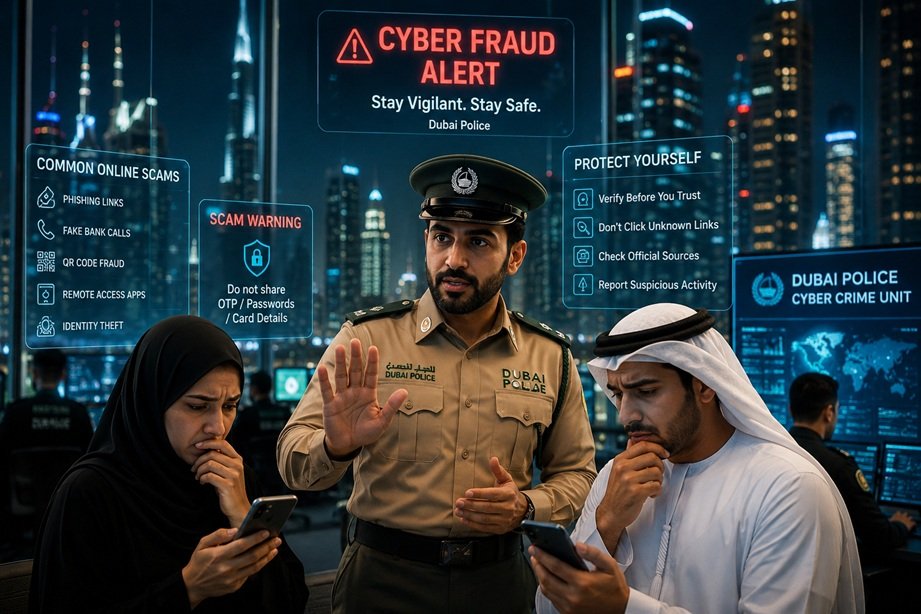
The landscape of online scams is changing at an unprecedented rate, prompting authorities in the UAE to express heightened concern regarding how cybercriminals are preying on the population via deceptive banking alerts, fake websites, and compromised card schemes. Recently, Dubai Police have continuously cautioned both locals and expatriates about advanced fraudulent methods that are pilfering banking credentials and emptying accounts in just minutes.
The most recent notification regarding cyber fraud from Dubai emphasizes how con artists are deploying social manipulation techniques, counterfeit customer support systems, QR code traps, and remote-access apps to deceive individuals into relinquishing sensitive information. These fraudulent schemes have become increasingly sophisticated. Many now successfully replicate official entities to such a degree that even those who are tech-savvy find it challenging to recognize them.
Experts in cybercrime assert that scammers are preying on emotions such as fear, immediacy, and trustworthiness. A call falsely alleging that one’s bank account has been blocked or a message masquerading as one from consumer protection agencies can swiftly induce anxiety in victims. Once personal information or OTP codes are divulged, perpetrators are often able to swiftly access financial accounts.
As reported by Dubai Police and cybersecurity organizations in the Gulf region, incidents of financial fraud associated with phishing and stolen card data are on the rise throughout the UAE. Authorities have ramped up educational initiatives urging residents to validate websites, refrain from questionable downloads, and always keep confidential information private in calls or text messages.
Methods Employed by Cybercriminals to Target Residents of the UAE
Cybercriminals are no longer dependent solely on random unsolicited emails. Contemporary fraud rings meticulously analyze user habits and establish believable traps that mimic trusted services. Numerous scams now replicate government websites, banks, delivery services, or telecommunication companies.
One particularly hazardous method involves fraudulent customer support agents reaching out to victims after they inadvertently provide details on deceitful websites. Dubai Police have recently cautioned that con artists are crafting counterfeit consumer protection platforms intended to gather names, phone numbers, and complaint information from victims.
Upon making contact, fraudsters typically aim to enhance their credibility by reiterating the details that the victim has previously provided. This technique renders the discussion seem legitimate and official.
Con artists then usually prompt users to:
- Download a “verification” app
- Set up remote access software
- Disclose OTP codes
- Access mobile banking applications
- Verify debit or credit card information
In mere moments, cybercriminals can replicate the screen of the victim’s phone, capture banking information, and execute unauthorized financial operations.
Deceptive Banking Calls Are Increasingly Persuasive
Telephone fraud continues to be one of the most significant cybersecurity risks within the UAE. Scammers frequently impersonate banking personnel, law enforcement officers, or government officials to coerce victims into sharing sensitive data.
Dubai Police disclosed that during investigations focused on banking fraud, numerous individuals linked to phone fraud schemes have been apprehended.
A significant number of victims report receiving calls stating:
- Their Emirates ID has lapsed
- Their bank account has been frozen
- Suspicious activities were noted
- An impending refund exists
- Their debit card needs verification
These calls are meticulously crafted. Scammers often employ operators fluent in both Arabic and English to enhance authenticity. Some even replicate official phone numbers, making the calls appear credible on the recipient’s device.
The increasing campaign against cyber fraud in Dubai is urging residents to promptly disconnect from such calls and reach out to their banks directly via official means instead of carrying on with the discussion.
The Surge of Fraudulent QR Code Schemes
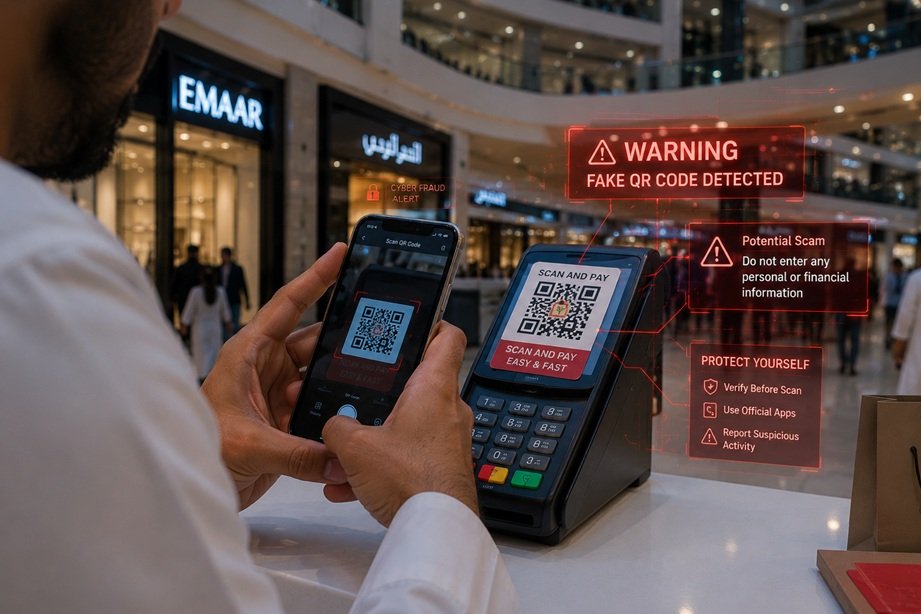
Scams involving QR codes are emerging as a significant issue in Dubai and throughout the UAE. Offenders are placing counterfeit QR stickers over authentic payment or information codes in accessible public areas.
When individuals scan the code, they can be redirected to deceptive websites aimed at stealing login credentials or financial information. In some instances, malware is covertly downloaded onto the user’s device.
Authorities have recently cautioned residents to thoroughly check QR codes prior to scanning them, particularly when making purchases or using customer service interfaces.
Cybersecurity experts advise:
- Steering clear of QR codes on damaged labels
- Verifying URLs before inputting any data
- Utilizing only official business applications
- Refraining from downloading unfamiliar APK files
- Confirming payment gateways prior to any transactions
Since QR codes seem innocuous, many individuals lower their defenses. This is precisely what scammers rely on.
The Misuse of Stolen Credit Card Information is Driving Online Fraud
A particularly troubling trend is the illegal sale and exploitation of stolen credit card details. Cybercriminal organizations frequently acquire card information through phishing schemes, malware attacks, fraudulent shopping sites, or data breaches.
According to specialists, fraud without the physical card has risen sharply since online purchases do not necessitate having the actual card present.
When criminals access card information, they might:
- Order high-value goods online
- Establish fraudulent digital wallets
- Purchase gift cards
- Conduct transactions internationally
- Sell the information in dark web marketplaces
Victims typically notice unauthorized transactions days later when reviewing their financial statements.
Dubai Police have consistently urged residents to vigilantly observe their banking activities and to block any compromised cards without delay if they notice any dubious transactions.
Financial experts also suggest activating instant transaction notifications via mobile banking applications so that unauthorized charges can be identified promptly.
The Dangers of Remote Access Applications
One of the primary risks noted in recent fraud investigations is the exploitative use of remote access software.
Scammers persuade victims to download programs that are allegedly necessary for:
- Processing refunds
- Submitting complaints
- Verifying banking information
- Troubleshooting devices
- Conducting security checks
In actuality, these applications grant criminals the power to monitor all activity taking place on the victim’s phone screen.
Dubai Police have warned that fraudsters employ these remote access tools to capture banking credentials and conduct transactions without consent.
Once these applications are installed, attackers may:
- Examine SMS OTP messages
- Record passwords
- Gain access to email accounts
- Launch banking applications
- Transfer funds remotely
Many victims only become aware of the issue after their accounts have been drained.
Cybersecurity professionals strongly recommend that any suspicious apps be uninstalled immediately and advise against downloading links sent through unfamiliar WhatsApp messages, SMS, or emails.
Social Engineering as a Fundamental Tool
Technology is not the primary threat in cybercrime. The human mind poses a greater risk.
Most contemporary scams thrive because perpetrators exploit emotions such as fear, urgency, trust, or excitement. This strategy is referred to as social engineering.
Fraudsters frequently construct scenarios such as:
- “Your bank account will be suspended today”
- “You have received a cashback reward”
- “Your delivery was unsuccessful”
- “Your card verification is awaiting completion”
- “Immediate action is needed due to a police investigation”
These notifications are crafted to pressure victims into making decisions quickly without proper consideration.
The recent warning regarding cyber fraud in Dubai highlights that official entities never ask for passwords, one-time passcodes, or bank details through unexpected calls or texts.
Experts in cybersecurity indicate that con artists often focus on times when individuals are preoccupied, anxious, or hurrying. This is why fraudulent activities frequently increase during holiday seasons, shopping events, or significant financial events.

How Residents Can Safeguard Their Personal Information
Avoiding online fraud necessitates both vigilance and maintaining good digital practices. Even minor errors can put sensitive data at risk of being exposed to criminals.
Professionals in security suggest several key behaviors that can significantly lower the likelihood of becoming a victim.
Create Robust Passwords
Weak passwords are among the easiest means for hackers to infiltrate accounts. Steer clear of obvious choices like birthdays or repeated numbers.
Instead:
- Develop lengthy passwords
- Incorporate special characters and digits
- Refrain from using the same password multiple times
- Update credentials frequently
Utilizing password manager apps can aid in creating secure combinations.
Activate Two-Factor Authentication
Two-factor authentication provides an extra layer of protection by necessitating verification in addition to the password.
Even if attackers acquire login information, they might still have difficulty accessing the account without the secondary verification process.
Review Banking Transactions Daily
Regularly checking banking applications can assist in spotting unusual activity prior to significant financial losses happening.
Numerous victims of fraud only become aware of unauthorized transactions weeks afterward.
Avoid Public Wi-Fi for Banking
Public Wi-Fi connections pose significant risks as cyber attackers can intercept the data being transmitted.
Professionals recommend utilizing secure mobile data options or reliable private networks when accessing financial accounts.
Verify Every Link Carefully
Phishing sites frequently imitate genuine websites. It is crucial to thoroughly examine the domain name prior to inputting login information.
Even a single incorrect character in a URL could be a sign of a deceptive site.
The UAE’s Expanding Fight Against Cybercrime
The UAE has made substantial investments in cybersecurity systems and digital crime investigations. The Dubai Police persist in enhancing anti-fraud measures while urging citizens to promptly report any suspicious behavior.
Authorities have initiated awareness campaigns in partnership with banks, telecommunications companies, and private enterprises to inform residents about cyber risks.
Victims and residents can report cyber offenses through:
- Dubai Police mobile apps
- The eCrime platform
- The non-emergency hotline 901
- Police Eye reporting services
Laws regarding cybercrime in the UAE also impose severe penalties for fraudulent activities, identity theft, and unauthorized access to digital systems. Investigators are increasingly utilizing digital forensics, biometric technologies, and international collaboration to pursue criminal organizations operating internationally.
Officials hold the view that public awareness remains a crucial defense against cyber fraud.
Why Scam Tactics Keep Evolving
Cybercriminals are continuously evolving their methods as conventional phishing techniques become easier to identify. As individuals grow more vigilant regarding suspicious emails, scammers are moving towards more targeted attacks.
Technologies such as artificial intelligence, voice replication, and sophisticated spoofing mechanisms are assisting fraudsters in crafting increasingly credible scams.
Certain criminal organizations even analyze local banking infrastructures, customer service practices, and regional communication styles to ensure their fabricated interactions seem genuine.
This persistent adaptation indicates that awareness of cybersecurity must be ever-changing. Strategies that proved effective for criminals last year may be entirely different today.
The ongoing campaign alerting about cyber fraud in Dubai illustrates how swiftly online risks are transforming within the digital realm.
The Financial and Emotional Impact of Fraud
The impact of cybercrime goes far beyond just financial setbacks. Victims frequently face feelings of stress, humiliation, anxiety, and frustration once they realize they have been tricked.
The process of recovering stolen funds can sometimes take weeks or even months depending on bank investigations. In certain instances, the stolen money may never be fully retrieved.
Businesses are also facing increasing challenges. Small enterprises targeted by phishing schemes or ransomware attacks may encounter operational interruptions, harm to their reputations, and loss of customer trust.
Cybersecurity experts indicate that the emotional tactics employed by scammers are specifically crafted to evade logical reasoning. Consequently, even intelligent and educated individuals may become victims of persuasive fraud tactics.
Recognizing this reality is vital since numerous victims may delay reporting incidents due to feelings of shame.
Authorities advocate for timely reporting because prompt action can enhance the likelihood of minimizing financial losses and tracking down criminal activities.
Digital Awareness Is Now Essential
The internet has become deeply embedded in banking, shopping, communication, and public services. While digital advancements continue to improve day-to-day life, they also generate new opportunities for cybercriminals.
The recent alert regarding cyber fraud in Dubai serves as a crucial reminder that safeguarding online security is no longer optional. Every smartphone, banking application, email account, and social media profile could serve as a potential target.
Maintaining safety demands continuous vigilance, awareness, and confirmation.
Community members must keep in mind several important guidelines:
- Do not disclose OTP codes
- Steer clear of unfamiliar downloads
- Scrutinize official websites thoroughly
- Disregard questionable banking inquiries
- Keep track of financial transactions regularly
- Notify authorities about any fraud attempts right away
Cybercriminal activities are expected to keep advancing, yet knowledgeable users are significantly more challenging to deceive.
While Dubai Police are ramping up their anti-fraud initiatives and awareness efforts, staying digitally alert is the best protection against more complex online scams.
Conclusion
The latest Dubai Police cyber fraud alert highlights how online scams in the UAE are becoming more sophisticated and dangerous. From fake banking calls and QR code fraud to remote access scams and stolen credit card schemes, cybercriminals are constantly evolving their tactics. Authorities are urging residents to remain vigilant, avoid sharing OTPs or banking details, and verify all online communications carefully. As digital fraud continues to rise, awareness, caution, and strong cybersecurity habits remain the best defense against financial loss and identity theft.